A well-fitted muzzle isn’t just about comfort - it’s about safety, security, and peace of mind for both you and your dog. The right muzzle allows your dog to pant, drink, and interact comfortably, while giving you control in situations where extra safety is needed. But with so many types and sizes available, it’s easy to feel overwhelmed.
This guide will walk you through everything you need to know to choose the correct style and size for your dog - from understanding muzzle types to measuring accurately - so you can shop with confidence and ensure your furry friend stays happy and protected.
Full video guide below, however, please scroll down to see some quick and easy reference guides.
Muzzle fitting video guide
Muzzle sizes and styles
In the Forever Hounds Trust shop, muzzles come in two main styles: box and basket.
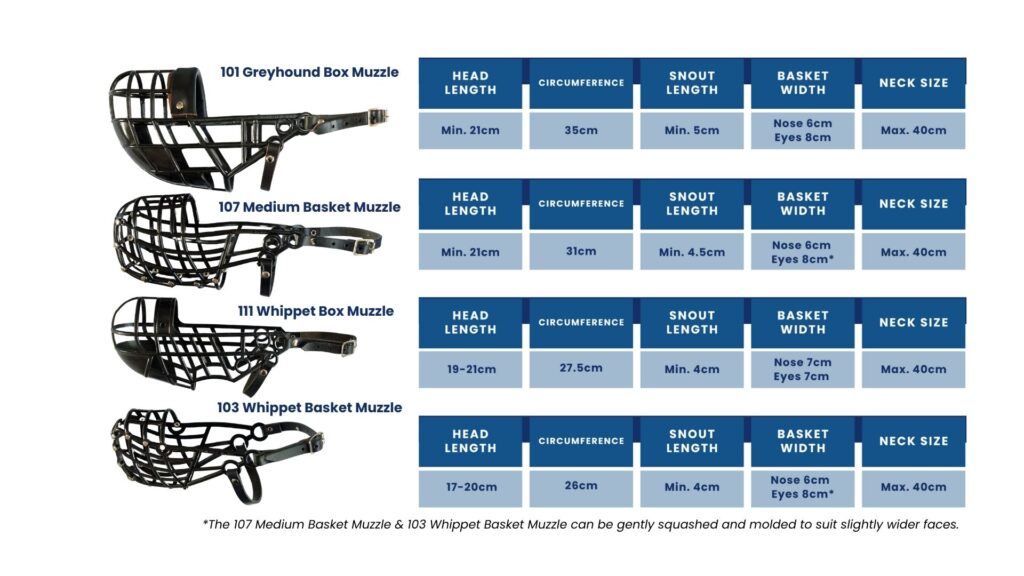
Box muzzles, like the 101 Greyhound Box Muzzle and the 111 Whippet Box Muzzle, have a more enclosed front section. This design is useful for preventing scavenging and for dogs that tend to break basket-style muzzles, for example through rough play or by knocking the muzzle against objects. They're a good option for travelling, kennel use, or for hounds who are particularly determined chewers.
Basket muzzles (the 107 Medium Basket Muzzle and 103 Whippet Basket Muzzle) have a more open, cage-like structure. This allows full mouth movement, so your hound can pant, drink water, and take treats while wearing it.
The whippet-specific options are scaled down to suit smaller, narrower heads and snouts, while the medium muzzle suits typical greyhound and lurcher proportions.
Which one suits your hound best comes down to their size and what you'll be using the muzzle for day to day; your rehoming or post-homing team can advise if you're not sure.
How to measure your dog
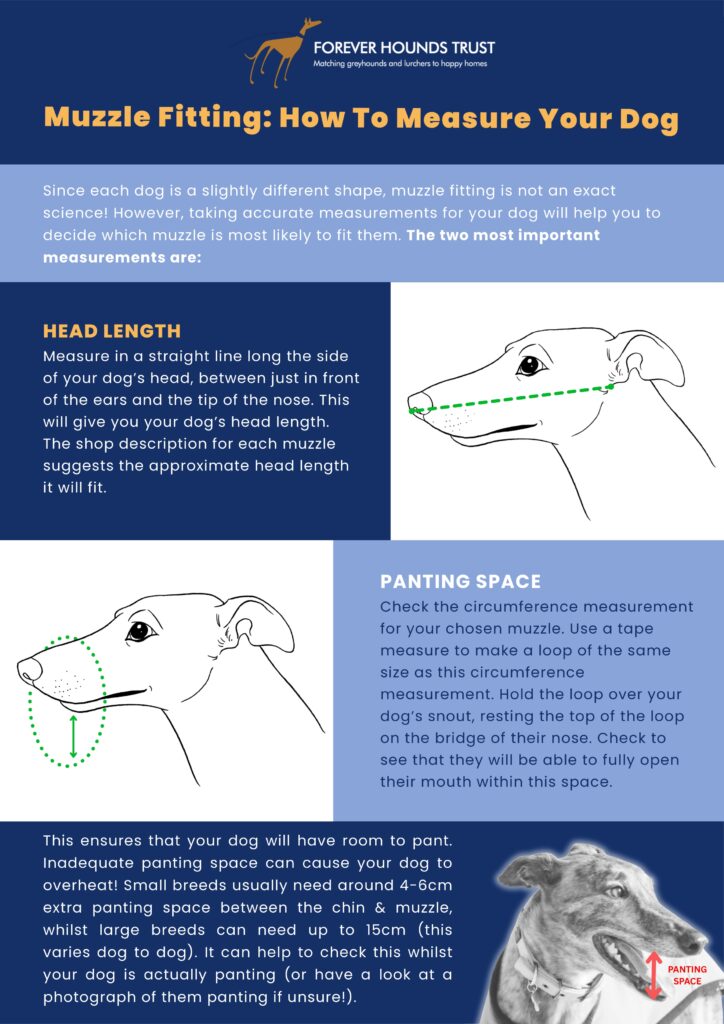
Since each dog is a slightly different shape, muzzle fitting is not an exact science! However, taking accurate measurements for your dog will help you to decide which muzzle is most likely to fit them. The two most important measurements are:
Measuring head length
Measure in a straight line along the side of your dog's head, between just in front of the ears and the tip of the nose. This will give you your dog's head length. The shop description for each muzzle suggests the approximate head length it will fit.
Measuring panting space
Check the circumference measurement for your chosen muzzle. Use a tape measure to make a loop of the same size as this circumference measurement. Hold the loop over your dog's snout, resting the top of the loop on the bridge of their nose. Check to see that they will be able to fully open their mouth within this space.
This ensures that your dog will have room to pant. Inadequate panting space can cause your dog to overheat! Small breeds usually need around 4-6cm extra panting space between the chin & muzzle, whilst large breeds can need up to 15cm (this varies dog to dog). It can help to check this whilst your dog is actually panting (or have a look at a photograph of them panting if unsure!).
Additional measurements
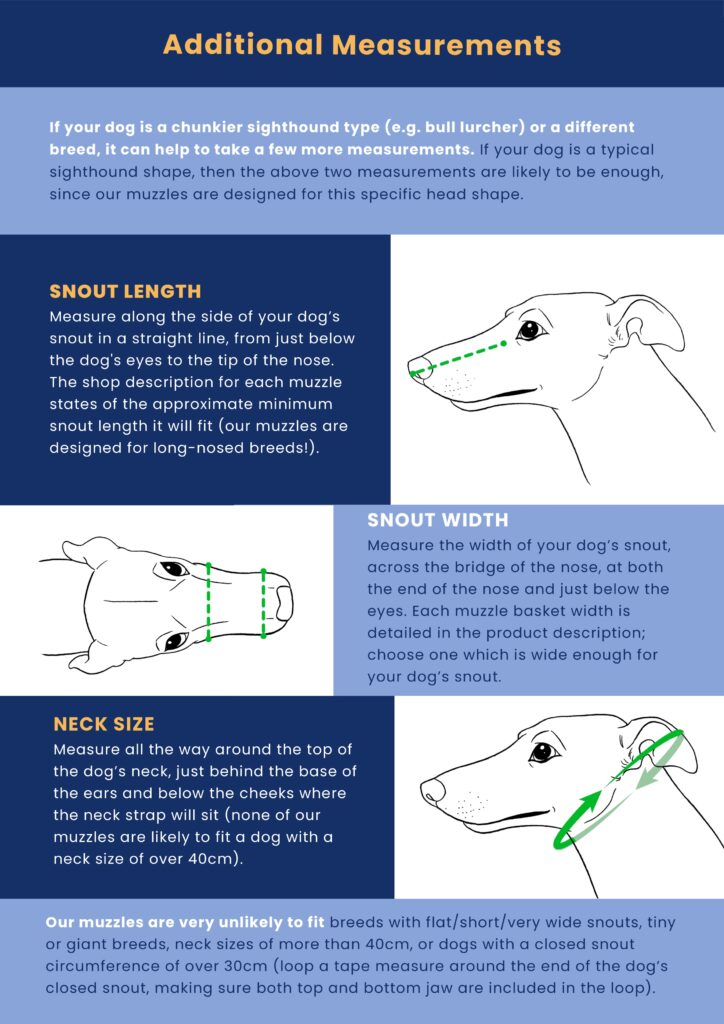
If your dog is a chunkier sighthound type (e.g. bull lurcher) or a different breed, it can help to take a few more measurements. If your dog is a typical sighthound shape, then the above two measurements are likely to be enough, since our muzzles are designed for this specific head shape.
Snout length
Measure along the side of your dog's snout in a straight line, from just below the dog's eyes to the tip of the nose. The shop description for each muzzle states the approximate minimum snout length it will fit (our muzzles are designed for long-nosed breeds!).
Snout width
Measure the width of your dog's snout, across the bridge of the nose, at both the end of the nose and just below the eyes. Each muzzle basket width is detailed in the product description; choose one which is wide enough for your dog's snout.
Neck size
Measure all the way around the top of the dog's neck, just behind the base of the ears and below the cheeks where the neck strap will sit (none of our muzzles are likely to fit a dog with a neck size of over 40cm).
Our muzzles are very unlikely to fit breeds with flat/short/very wide snouts, tiny or giant breeds, neck sizes of more than 40cm, or dogs with a closed snout circumference of over 30cm (loop a tape measure around the end of the dog's closed snout, making sure both top and bottom jaw are included in the loop).
Quick reference images for muzzle fitting
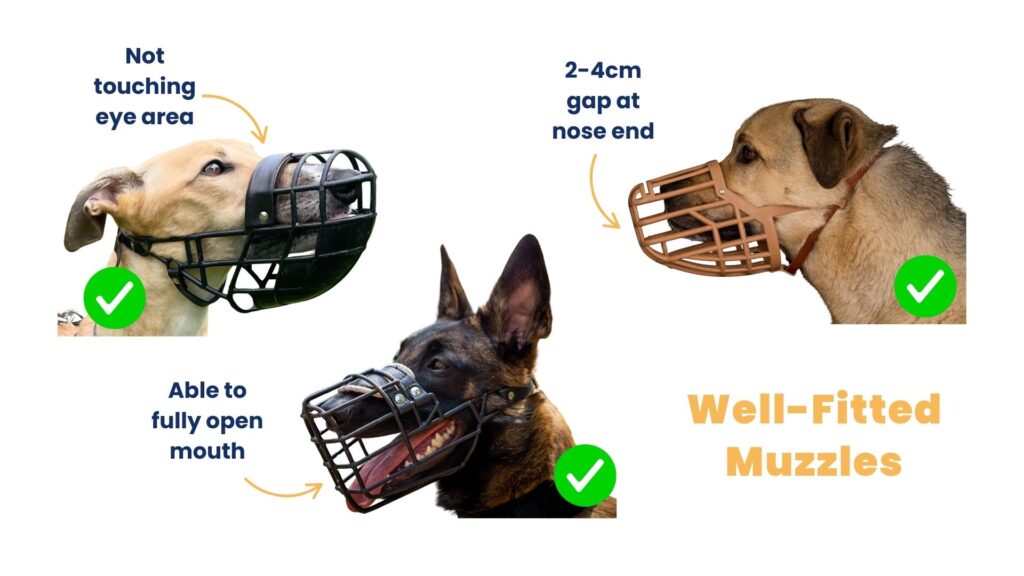
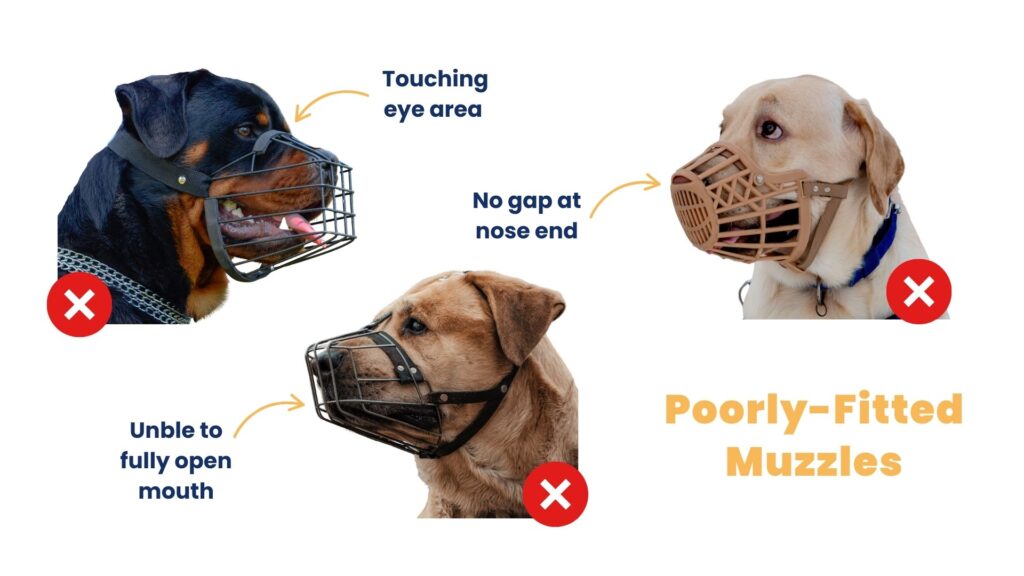
The do's and don'ts of muzzles
A well-fitted muzzle allows your hound to pant, drink, and interact comfortably. The muzzle should not touch the eye area, should leave a 2-4 cm gap at the end of the nose for comfort, and enable the dog to fully open their mouth.